

The current crisis is a teaching moment for Republicans about how money works in the modern age.
Republicans destroyed trillions of dollars over the last several months. All that money lost in homes, in stocks, in bonds — it disappeared.
That money can be replaced. You just have the Federal Reserve declare it. That's what the $350 billion bail-out was. The government got authority to create the money, it's new money, replacing what was lost. The bait-and-switch, the fact it was not used to get rid of Confederate Money and was instead used to line bank vaults, does not mean the new money does not exist.
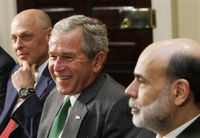
But as we see, it was wasted. Squandered. Stolen. When we create new money, without new value, we get nothing for it. I was wrong about the bail-out. I assumed the former head of Goldman Sachs would understand what to do. He did not. He thought if he gave the money to his friends that they would start making loans with it. He was wrong. We were robbed.
The best use of new money, money lost in homes and stocks and bonds, is to create new value. Business will then bid on that value and new, even stronger money will be created.
A great example is rural electrification, perhaps the longest-lasting benefit of the New Deal. Agencies like the TVA brought electricity to places that never had it before, so manufacturing could be done at "green field" sites far from cities. (Interstate Highways, another great creation of government money, accelerated the trend.) These projects created the Sunbelt, providing enough electricity to change the indoor climate.
Another product of the 1930s, Hoover Dam, made Las Vegas and America's salad belt possible. Parkways built during this period made suburban Long Island possible, and parks developed during the period created the modern recreation industry.
Where did the money come from? We created it. What resulted? Enormous value, which the private market then unlocked.
This is the proper model for using new money. If you give it to your friends, as Paulson did, it does nothing. If you invest it on things that will provide value over time, you get both the immediate benefit of the spending plus the long-lasting benefit of the spending's result. It's what we tell children about money all the time. It's true.

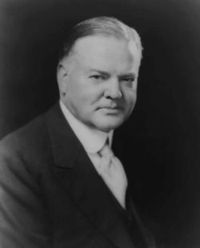
Perhaps the biggest mistake made by Reaganism was its refusal to invest in 30-year projects like those just described. As a result our infrastructure, on which business' economic opportunity is based, has crumbled. We ate our own seed corn. In retrospect, Hoover was a better President than Reagan.
Since 1980 we have lost ground in science, our roads are a mess, we're behind in every possible way when compared with markets like China. The only thing we got for our government deficits was this enormous military machine. We tried exporting it in the 1990s, and we used it this decade. What's left of all that value? Nothing.
The point is, money is what you do with it. If you lose it we can replace it, assuming others see the value in it. (Otherwise you get hyper-inflation.) If you just give it to your friends, or waste it, all you can possibly get is the economic use of its spending later on. If you use it wisely you get value which provides benefits to you and your posterity.
So that is what we must do. We can grow our economy for both the present and the future, at the risk of inflation and the short-term loss of our money's value against currencies whose governments refuse to act. We can act as Germany and Japan are acting, stagnating as those economies are stagnating. Or we can act as the Bushies acted, handing out money to our friends and getting the short-term benefit of their short-term decisions.
The good news is we have chosen our path. The challenge is to invest in projects that offer the greatest long-term value to our economy.
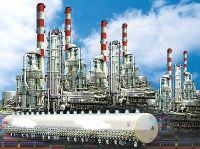
- Re-electrification, an electrical grid as flexible as the Internet, that can both buy and sell power, storing the excess as needed in the form of hydrogen. Winning the War Against Oil is the best thing we can do for our grandchildren.
- Improved ports and roads so our goods can make it to the world's markets and our own. (There's danger in this — if we put it into low-skill work that work will be done by low-skill people, possibly by new immigrants.)
- Education and health care, because our human resources are the 21st
 century's most important determinants of economic growth. You are our freeway.
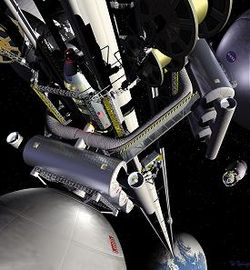
The best use of this money is in grand scientific projects, like the Space Elevator, not just for what they could be (a cost-effective way of getting out of the gravity well) but because of what we'll learn along the way. That's what Apollo was, a dream not just for today but for tomorrow.
Tomorrow. That's the best use of new money. Building tomorrow, doing it together, and then letting business find opportunity in it.



Thank you, Dana, for recognizing the damage of Reagan’s policies. When I try to explain the lunacy of his administration to younger people, they think I’m daft.
You’re right. Bankers have taken the money, and now they refuse to tell us what they’re doing with it. Incredibly, such accountability was not part of the bill; recall that what was important is that we pass it NOW! NOW! NOW! NOW! NOW! according to Paulson. Why? NOW! NOW! NOW! NOW! we were told.
The interviewer on 60 Minutes asked Schwarzeneggar about green initiatives and how “you can no longer push those in a bad economy.” Too bad Schwarzeneggar didn’t say the obvious: “If you can’t do it when you need it most, then when?” We didn’t do it during good times, and you say we can’t during bad times, then when indeed!
It’s deeply shameful to me that we don’t have a viable rail system in this country. How much would a bullet train from NYC to DC cost? How about others like Chicago to St. Louis? Atlanta to Miami? Kansas City to Dallas; Dallas to Phoenix, etc.
PS:
But we always find the money for more war, don’t we? What value have we seen from six years (longer than WWII!) from that?
Reagan’s Missile Defense Project (aka Star Wars) turned into a 30-year project. Certainly not the best use of that money, though.
Reagan’s Missile Defense Project (aka Star Wars) turned into a 30-year project. Certainly not the best use of that money, though.