


What is the most heavily subsidized business in America today?
Sports.
What other business routinely blackmails cities, counties and states into building billion-dollar palaces for its use, then giving these over to billionaires, complete with all the revenue, and no accountability?
What other business can control its own press coverage to the extent sports does?
Imagine if Rod Blagoyevich could have enforced something like that!
Yet the biggest subsidy for the sports industry does not come from government, but from journalism.
Every newspaper sports page is a commercial for the teams it covers. Reporters don't actually pay to cover games, the way TV and cable outlets pay to broadcast games, but they are more important than either. Because, as Mark Cuban admitted at his blog this week, they bring in the casual fan.
With local print journalism about to go extinct the industry is losing its connection to the casual fan, who brings with him (or her) an acceptance of all the other subsidies. Without the acceptance of the casual fan, how can cities be blackmailed into building sports palaces and giving them to team owners, or how can university alumni be blackmailed into putting millions of dollars into coaches' pockets in hopes that alma mater will get a mention on ESPN?
Newspapers provide more than coverage to sports. They provide cover. By giving sports prominence alongside government, crime, and Dilbert, they create the illusion that the results of such contests are serious news, and that a championship is "making history." Take away the illusion and it's just a TV show.
Cuban's own proposals on this front are, frankly, pretty lame. Subsidize beat writers through some central authority? And how do these reports then reach the casual fan?
It's not the writing that's the problem. It's the distribution, the wide distribution newspapers provided for over a century. Some of that is held by TV, but local TV news has been losing share as fast as the newspaper industry, and it has been cutting its sports coverage as outlets like ESPN take a greater hold on the imagination.
If newspapers had made better use of the Web we might not have this problem, at least not to as great a degree. We would have it, still, because there are still people who don't go online for whatever reason. But publishers ignored every piece of advice from everyone with A Clue for too long, and now lack the capital to command their online markets even if they had the skills.
The answer, for both sports and newspapers, is the same. Or was. (The cost of doing this goes up every year even while the chances of success decline.) It's a single word.
Directory.
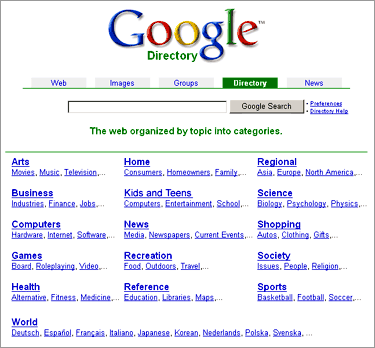
Journalism exists to organize and advocate a place, industry or lifestyle.
In moving online, all of journalism ignored the first half of this charge, to organize.
So Google did it. Social networks did it. Craigslist did it.
Newspapers did not do it because (they thought) the phone companies had already done it. Which they had, to a very small degree.
Through Yellowpages.com I can find the number of any local store. But that doesn't tell me if the store is any good, or if it's likely to have what I need.
In terms of Cuban's problem he should not be hiring writers. He should be building a Web site, which I used to think was his business. Or hiring people to build one.
Such a site would first aggregate all local sports coverage online, whatever its source, and let the casual visitor know as soon as a story hit of interest. This is not hard. RSS readers and Google News already do this. So do some sport sites.
Next, build in social networking. All the tools you would see at a site like Facebook. Then add interactivity, including hosted chats during games, accessible via mobile phone, encouraging those at the event to share their thoughts with people watching at home.
When people build their own pages, you give them an icon, or icons, representing the local teams they are interested in. You have them bring in friends, offering incentives all along the way. What kind of incentives? Tickets and swag, tied to the icons they have chosen.
You collect addresses and over time link fans to others who live near them and share the same interest. Meet-ups! And when there's a Meet-up there you are, with more swag, and maybe a special guest — a player or executive or a coach or the geek who sends out the press releases, maybe even one of the site's bloggers.
It's an organic process. The site must look professional at launch, and unbiased, unbossed, credible. What you're building are directories of each local team's fans, in concentric circles from the most avid to the more casual.
You are seeking to draw more than advertising. You are seeking to build intimate, interactive relations between fans and their teams, and among those fans. You are building communities.
That's what newspapers used to do. That's what people are missing in their lives. Sports can be a great catalyst. But someone has to re-start the reaction.



I agree that newspapers have been asleep at the tech wheel for the entire history of the modern web. TV and newspapers get in the way of news with ads and strange personalities like chris matthews, rachel maddow, sean hannity, campbell brown, and the clear loon who goes by the name of bill o’reilly. TV is the last place I want to get real news, at least in the US.
For newspapers, their costs are simply too high to keep the business viable. Adding more crossword puzzles and comics they can’t afford isn’t going to help.
A friend is a beach volleyball pro, so I follow the sport and watch how they interact with fans.
They don’t get much in the way of tv coverage (except for a few players at the olympics), so the focus is on connecting fans who come out to the beaches around the country for tournaments. Various web tools – they could do much more and the financials of the sport are suffering, but they see their growth in building an online fan base.
I’m curious to see if some of the minor sports may become more important as money goes out of the majors (there is a bit of a sponsor implosion going on now)
A friend is a beach volleyball pro, so I follow the sport and watch how they interact with fans.
They don’t get much in the way of tv coverage (except for a few players at the olympics), so the focus is on connecting fans who come out to the beaches around the country for tournaments. Various web tools – they could do much more and the financials of the sport are suffering, but they see their growth in building an online fan base.
I’m curious to see if some of the minor sports may become more important as money goes out of the majors (there is a bit of a sponsor implosion going on now)