Think of this as Volume 12, Number 16of A-Clue.com, the online newsletter I've written since 1997. Enjoy.
Why have so few of us reached space? Why is even the International Space Station a fraction of the size most sci-fi writers predicted a half century ago?
Cost. Specifically the energy cost of getting out of Earth's gravity well.
It's not that people have lost interest. When a company called Solaren announced a deal to install solar panels in space and sell the resulting power to PG&E early this week, so many people rushed to the rail that Solaren's site quickly exceeded its bandwidth limit and was taken down.
The deal is pie-in-the-sky. It was the utility's presence in the story that made it newsworthy, but in fact that company risked nothing. If Solaren gets its system working PG&E will buy its power. If.
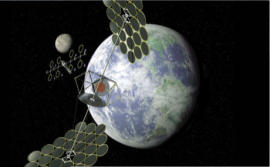 Just as with "competitor" Space Energy (left), Solaren's business model depends on low-cost space lift to make it work. But with low-cost transport out of Earth's gravity well start-ups won't be needed. Outfits like GE will be happy to play, and are certain to dominate.
The Air Force has been working on lower-cost space lift for years, but the solution that makes economic sense, first imagined by the late Arthur C. Clarke, is the space elevator. The key to the elevator, in turn, is a material that can be spun into a single line reaching 22,300 miles (35,888 km) into the sky.
For years the best material for such a line has been assumed to be carbon nanotubes, what we Rice people call buckytubes. But no one has yet been able to make a buckytube as much as a foot long, let alone miles.
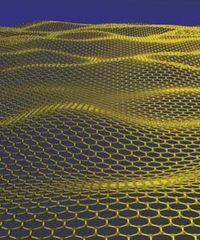 But what if you could split a nanotube, then knit the tubes together? The result would be something called graphene (picture from the blog of Kavi Khedo). The graphite in pencils consists of sheets of carbon, hence the name.
Nature reports on efforts at Rice and Stanford to "unzip" tubes into graphene. Stanford's etching process and Rice's chemical process both hold some promise, although it's the Rice technique which seems capable of making the longest ribbons, which could be spun into long, conducting fibers. (The Stanford ribbons are semiconductors.)
The dream of space, in other words, remains in the laboratory. That's true for all applications, including the War Against Oil.