

 As I promised in my earlier piece on Bob Metcalfe, the focus of my 1971 Game is less on politics or economics, and more on technology.
My thesis is that renewable energy is roughly where computer technology was in 1971. That is, it's available, it's expensive, the technology is very basic, the space is growing, but it's not something everyone has.
This is especially true in solar technology, which is the renewable resource that is most subject to Moore's Law. While it's true that efficiency of solar cells isn't going to double every year or two (it would quickly get to 100% from the current 10-15%) there are many dimensions for improvement, which when combined are driving prices down quite quickly.Here's a partial list:
- Basic Efficiency. Current thin film technologies are only 8% efficient. But we've seen 20% efficiency described by many people.
- Installation Cost. Right now it can cost thousands to put a solar array on your house. Standardized contracts, fittings, connectors, panel sizes, and designs can reduce that substantially.
- Useful Life. Right now solar cells may degrade completely after about 20 years of use, and they degrade substantially over time. Extending the useful life, increasing the efficiency of an older cell, lowers costs.
- Materials. The great "rare earth" scare is based on the idea that solar cells must be made with things like cadmium, which are expensive to mine and cause environmental damage. Many other materials are being tested that can do the same thing at lower cost.
- Manufacturing Costs. A less efficient system can be better and cheaper than a more efficient one if its manufacturing can be scaled-up effectively. This is First Solar's secret sauce — they know how to make their stuff.
- Manufacturing Process — There are many parts of the manufacturing process that can be improved, where costs can be taken out. Ultimately you want something you can print, like a newspaper or photo paper. Kodak is working on that.
This is why I insist Moore's Law is applicable to solar systems. Combine small improvements along each of these lines, multiply they over time, and you do indeed get falling prices, rising efficiency, and new markets opening up.
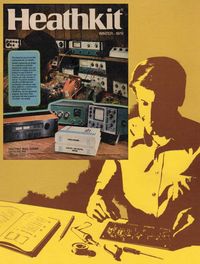
But let's get back to our subject, OK? Heathkit was a big deal in the 1970s. The company built kits from which you could build electronics devices. They served hobbyists and enthusiasts, the very front of the s-curve. And from these enthusiasts emerged nearly all the leaders of the eventual PC revolution. Steve Jobs, Steve Wozniak and Bill Gates all engaged in computing as a hobby in the early 1970s.
So Heathkit has a very important historical role in the development of the PC market. It is a limited role. Their attempts to build full-fledged Heath computers flopped. Their markets moved on. Once mass production was turned toward the PC, Heathkit made no sense. You can, however, see the remains of their day if you venture deep into any Fry's store. There are still some people who buy parts and make stuff because it's fun.
Anyway, who's Heath now?
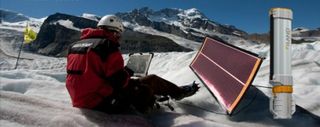 There are many candidates for this honor. They're all in the same business — providing consumers with do it yourself solutions for using solar power to charge devices, things like phones, PCs and iPads.
- Suntactics, founded in 2009, makes some nice solar chargers for devices, through a local manufacturer. Their latest offering is the sCharger-5, capable of delivering 5 watts of power and (more important) allowing you to use device while it's charging. Reviews for this are pretty good.
- iLand, a company based in Switzerland that specializes in solar chargers that can be taken into deep wilderness. Their latest is a 16 watt unit that folds out on a stand, which can be illuminated with built-in LEDs and can handle water filtration units as well as USB and car socket plug-ins.
- PowerTraveler, a British company whose niche is charging systems for international travelers. So in addition to solar chargers, they make a variety of charging systems with a variety of connectors, linking to a wide variety of electrical grids. Their latest solar charger, the PowerMonkey Xtreme, costs about $200.
- thousandsuns, another British company which, along with a French outfit called Laserjet, now offers the SolarPod, a 9-pound case which combines with the company's existing solar panels to create a do it yourself home power system. When fully charged it can run a TV all day and night.
- voltaic, whose Spark can recharge your iPad while it's on your back. It's called Spark, and they have a whole line of solar cell-equipped backpacks, computer bags, stand-alone solar systems and plugs. Their blog features cool projects like the use of solar to run a wireless sensor network, essentially turning an always-on home automation system into something you don't need to plug in.
- GoalZero, a Utah company that is just as much a catalog seller as it is a device company. (Both are vital in creating a market.) Their niche is similar to iLand, adventurers, but in this case it's mainly day trippers.
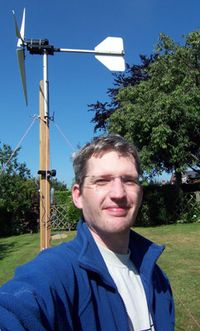 But the winner is this guy: Ben Jandrell of Gotwind.
Jandrell writes he's been working on renewable energy projects since 1981, which is before I got my first PC. His site offers both products and projects. Products like these Power Wellies, a pair of boots that can recharge your phone. Projects like a wind power Dynahub whose schematics you can purchase. (Very Heathkitty.)
Or take a gander at his StreetCharger, a system that can power up to 20 mobile phones. Perfect for an African or Indian village that is just getting into mobile communications but is otherwise off-the-grid. It can be stripped down for shipment as a single box, and I think it's cool that Ben went out inventing the thing, even perfecting it, before considering the problem of how to export it.
Someone needs to take this fellow by the hand and make him rich.




Thanks for the memories. My father built several Heathkit items back in the ’70’s. Of the ones I remember, he built a ham radio, my mother’s organ, and a TV, which I inherited when I went off to college.
Thanks for the memories. My father built several Heathkit items back in the ’70’s. Of the ones I remember, he built a ham radio, my mother’s organ, and a TV, which I inherited when I went off to college.
Your blog is somewhat interesting. I’d learned a lot in this post and I think I travel nicely.
Your blog is somewhat interesting. I’d learned a lot in this post and I think I travel nicely.
Climate change concerns are driving increasing renewable energy legislation, incentives and commercialization. Government held the vital role for this phenomenon.
Climate change concerns are driving increasing renewable energy legislation, incentives and commercialization. Government held the vital role for this phenomenon.
Good list of portable solar power equipment links you have created here!
Good list of portable solar power equipment links you have created here!