Think of this as Volume 16, Number 21 of A-Clue.com, the online newsletter I've written since 1997. Enjoy.
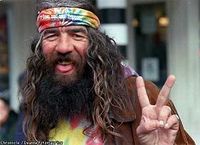 The hippies of the early 1970s were, by and large, good people. Good-hearted and idealistic.
But they were completely out of touch with the political zeitgeist of their time, as we now know. Anyone even remotely associated with their idealism was pushed out of the political mainstream starting with Nixon. Watergate and the Carter election fooled some into thinking this wasn't the case, but normal service was resumed by 1980. After that, the ideological knees jerked whenever the strings were pulled for a generation.
This is the main result of a crisis election, a change in the political zeitgeist, so that the rising generation's assumptions about life and politics become dominant. Opposition to them must then be couched as “yes, but,” accepting the premises but leaning into them. That's what Bill Clinton did, and what Dwight Eisenhower, Woodrow Wilson, and Grover Cleveland did before him.
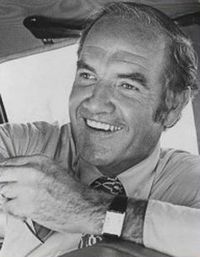
Before “yeah but” can be a viable strategy, of course, the old playbook must be re-run one more time. The McClellan Democrats, the Bryan Democrats, the Landon Republicans, the McGovern Democrats. They need to be led by avatars of the old order, but what the rising tide will focus on will be its bleeding edge, those “hippies” whom no one should listen to, now or ever again.
Who are the “hippies” of 2012?
 Foster Friess. Sheldon Adelson (below). Joe Ricketts. Frank VanderSloot (right). The billionaires brigade that is using its own money to try and hijack this election are the hippies of 2012.
There is enormous fear of these men, and their fellow hippies, in Washington right now. Just as Nixon feared the McGovern Democrats. But there is precedent for not fearing them, for seeing them as a positive indicator.
The American Liberty League. They sued to stop the National Labor Relations Act. They called Social Security “the end of democracy.” Big business, needless to say, hated the New Deal. FDR “welcomed their hatred” and thereby assured his political legacy.
In the billionaire hippies we have the same ingredients we had then. We have great wealth opposing reform. We have domination of the media through the money of these people. We have bogus claims of non-partisanship that are easy to refute.
And it's a gift that the President has yet to fully embrace. The President's base has yet to be energized by this election, which is why it now seems closer than in fact it is. Republicans are unified, mainly in opposition to the Administration but unified. Democrats are also unified, but not as enthusiastically as they need to be.
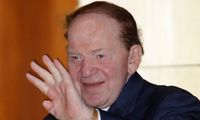 But the President has this political gift, his ace in the hole. The real contempt most people have, even many rich people have, for people like Friess and Adelson and VanderSloot, who lack even the media infrastructure “Citizen Rupert” Murdoch has to make black appear white and white, black. They are a huge target, they are low-hanging fruit, they're the Republicans' soft underbelly.
And when push comes to shove, as it always does in political campaigns, this President will use them to obliterate his opposition, and solidify his governing coalition. As Lincoln did after the Battle of Atlanta, as McKinley did after the Spanish-American War, as FDR did with his speech welcoming their hatred, even as Nixon did with Agnew.
Fact is, every crisis in America's political history has carried echoes of those crises that went before. The partisan divide of our time is much like that of the Nixon era, which is why so many “analysts” think the President is in trouble – they can't conceive of history before 1972.
The economic crisis of our time was echoed by the New Deal, when demand needed to be ginned up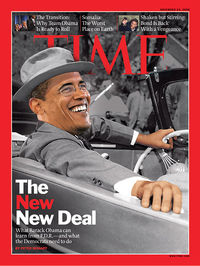 in order to get people to work. The underlying issues – the rights of workers – are reminders of the Progressive era. And the blind hatred of the opposition, its utter resistance to facts, is very much like the Civil War era.
When the wheel of history turns, it turns completely. The wheel of our history turned decisively in 2008, after New Orleans, after Iraq, after Terry Schiavo, after the Big Shitpile and the Great Meltdown of that year. We're not going back there. Not now, not ever. Republicans may think it unfair, but we're going to wave the bloody shirt of that time from now until I'm in my grave.
That's what history will say of our time. And it starts with destroying the billionaire hippies, in welcoming their hatred, in defying their will, and in handing them a nice big cup of STFU.