Think of this as Volume 18, Number 45 of the newsletter I have written weekly since March, 1997. Enjoy.
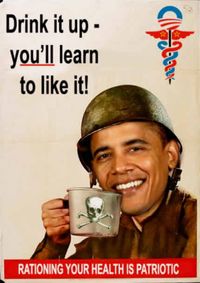 What’s unique about the present crisis, which began in 2008, is that it has been so slow moving. It has been slow moving because it has been, for the most part, non-violent. It has been non-violent, in large part, because Barack Obama has refused to give-in to liberal Democratic calls for him to be more confrontational.
That makes sense when you understand the Obama Thesis of Consensus, which I first wrote about under that name almost six years ago but had been describing, under other titles, for almost three years before that.
Consensus implies that people come to agreement, despite sharp disagreement. If consensus is what you’re looking for the last six years have been a complete failure. Republicans continue to play politics based on the Nixon Thesis of Conflict , and most Democrats today want to play the same game.
Which leads me to this startling conclusion. Barack Obama threw the mid-terms.
 The campaign was ridiculous. Democrats had all the issues. A higher minimum wage is hugely popular. Democrats barely mentioned it. Democrats have huge advantages on social issues like marriage equality. They have huge advantages on questions of war-and-peace. In all these areas Democrats are significantly to the left of where the President seems to stand. The wind that was blowing from the right in 2008 seems now to be blowing from the left.
Contrast the Obama record after six years with what his predecessor had at the same time, and there’s no comparison. Yet the President refused to blow that way. As a result, Democrats deserted him. He became as unpopular as George W. Bush was in 2006, over issues like the NSA, enforcement of the Patriot Act, and net neutrality. The party deserted its leader and paid the price.
 This only makes sense to Barack Obama if you’re truly playing a long game, and if your aim is not victory but peace. Republicans now have two choices, and the outcome in either case hurts their case for conflict-based control going forward.
On the one hand Republicans could cooperate with the President and get compromises passed. This will upset their base as much as that of the Democrats, and the President will wind up with most of the credit.
Or Republicans can try to force the President’s hand, becoming ever-more extreme and out-of-touch with the way Americans feel on a whole host of issues. This practically guarantees that Obama’s successor will be a Democrat, and it’s the Presidency – nothing else – that is the prize.
As I’ve said before, every crisis period recapitulates parts of the crises that came before. Our present politics has things in common with 1974, with 1938, with 1902 and with 1866. In all these cases the proximate cause of the crisis seems to have passed. But the real change is still hidden from view.
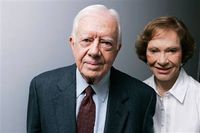 A friend asked me recently, “Why do people still hate Jimmy Carter?” It’s because Carter, in his time, was so out-of-step with how politics was actually moving. He was a President completely outside his time, a voice from the distant future, from our time in fact. He was a liberal at a time when the country was becoming increasingly conservative, a conciliator at a time when the country was becoming increasingly confrontational. He was an accident, elected only because of Watergate, and because Ford pardoned Nixon. Yet he persisted in acting like he had a mandate. He still does. It doesn’t help that, in every conceivable way, what he said was right and what his critics said about him was wrong. It was still infuriating, and remains so.
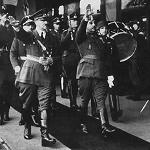 What the present day has most in common with past times of crises is 1938. What seemed the proximate cause of the economic crisis seems to be passed, the economy is now growing. The money that disappeared into the Big Shitpile has been replaced. But looming ahead is the larger crisis, the one that was always there to begin with. In 1938 it was represented by Adolf Hitler, a frank rejection of democratic government and institutions. In 2014 it is represented by ISIS, but also by Vladimir Putin, and in America by the John Birch Society, the creature of Fred Koch, father of today’s Koch Brothers, who have engaged for years in a slow-moving coup, first taking the courts, then the Congress, and gunning for the Presidency itself.
The real conflict of our time is not between left and right, but between confrontation and conciliation, between absolutes and muddling through, between the processes of war and peace. The heart of the Obama Thesis of Consensus is a call for peace, for reasoning together, for compromising, for getting along. It’s that which seems to have no constituency.
 Managing that crisis takes a lot of moving parts. You have to understand that the Internet is part of the battlefield, and fight on that battlefield. You have to understand that economics is part of that battlefield, and fight on that battlefield. You have to understand that the breadth of alliances is definitive, as it was in FDR’s time, and that to an extent holding your cards close to your chest is the only way to win.
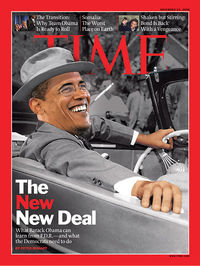
After 1938, Franklin Roosevelt moved toward confronting Hitler with no cooperation from the Congress, which after that year was completely controlled by a coalition of Republicans and southern Democrats. What he had were diplomacy and the propaganda tools of the radio and movies. He had to find a way to convince the country to confront its real threats, and he did.
That’s precisely the situation that Barack Obama finds himself in now, and I think deliberately. All the policy initiatives are aligned. Most Presidents become more popular near the end of their terms than they were earlier. Bush was actually more popular in 2008 than in 2006, despite the Great Meltdown. Clinton left office wildly popular, and Reagan was popular enough to name his own successor.
 The policies needed for a similar run are all in place, and there is nothing that Republicans can do to stop them. Obamacare will continue. The Gulf Arabs are cooperating in policies that will put intense pressure on Iran, on Russia, and coincidentally on the American oilmen so dedicated to pulling Democrats down. The renewed pressure of Republicans is going to draw Democrats back to the President.
What matters most to a generational thesis is that it’s validated by events. Not just domestic political events, but by economic events, social events, and global events. And not just over a day or a month or a year but decades, lifetimes. The fact is that the world is becoming more peaceful, that millions keep entering the global middle class each month, defusing the population bomb. The fact is that renewable energy is now ready to stand on its own, defusing the climate bomb. The fact is that health care policy is prepared to reduce the percentage of GDP going to health care, defusing the fiscal bomb.
What America will most want in 2016, and what it will assuredly deserve, is a raise. As unemployment continues to decline, pressures for higher wages will increase. As deflationary pressure increases the need for new money coursing through the economy will also increase, and it makes a lot more sense at this point to give that money to people than to bankers, something even bankers are coming to realize.
So you hand Republicans the bridge, and you let them try to steer the ship onto the rocks, despite the presence of clear water ahead. They come to look ridiculous. They can either agree to the new course or stand for the stupid in the face of overwhelming evidence that stupid is, well, stupid.
So we get some small agreements, which upset the Republican base. And the ship keeps heading toward clear water. And the American people validate the new course.
But could that plan have worked had Democrats won the midterms?
No.