Think of this as Volume 18, Number 48 of the newsletter I have written weekly since March, 1997. Enjoy.
 A few weeks ago I posited the theory that President Obama threw the last election so that Democrats can come back stronger in 2016 and beyond.
But there’s another theory, and it’s based on a recent visit to the suburbs.
Atlanta is divided into two parts. I live Inside the Perimeter (ITP). Most of the city is Outside the Perimeter (OTP), the I-285 ring freeway dividing them from one another. I’ve been surprised that anyone could be against this government since life is great ITP. My home’s value has increased, there are tons of new shops and restaurants opening up within walking distance, and the new intown malls built over the last 10 years are crowded all the time.
As I’ve written here many times, the center of our economic life is changing. It’s moving from offices to labs. Most of the jobs done in office towers – marketing, middle management, etc. – can now be done by computers. Those jobs aren’t coming back.
 The Mad Man era is over, Willy Loman is now an algorithm, and if Dan Draper can’t code he’s hitting the bricks alongside him. The offices that remain are basically factories, software factories. Atlanta is lucky to have so many software companies, especially in complex areas like transaction processing, which happens to be where my wife has made her career.
S0 economically, things are great in my household. I have been doing pretty well moving my beat from technology to finance. She has been doing great at her job, which she’s very good at. Our assets have grown substantially in the last six years, and our lives much more convenient. It has been a great time for us.
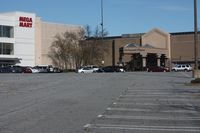 But when I drove OTP recently, on the hunt for a PC that we wanted to get our hands on before we bought, the story was very different. Fry’s, the computer store that used to be a wonderland at this time of year, was literally devoid of stock. We were told that the shelves would be restocked for Black Friday, but I looked at the store’s warehouse area and that wasn’t full either. Fry’s is getting killed by Amazon and, to a lesser extent, by Best Buy, which can use smaller stores and a robust online presence to offer the same values Fry’s does in its warehouse-like space.
Things were worse when we went outside. The Gwinnett Place Mall next to Fry’s is nearly empty. You might think that the “big box” retailing area nearby would be picking up the slack, but much of it is now see-through. There are oceans of empty blacktop out there, fronting acres of empty storefronts.
 Georgia’s politics during the last decade were dominated by one industry, real estate. Suburban real estate needed government to build roads. Roads made commutes just a little easier, and they were used by developers to build cul de sac suburbs which fed into the roads, quickly overwhelming them so that commutes became ever-longer. Suburban sprawl spread as far as 50 miles out, in some directions.
But all this died in 2008. When growth is centered in research, it pays only to live near places like Georgia Tech, Emory, and Georgia State University, the area’s three great research institutions. Schools like Kennesaw State, in the suburbs, are teaching institutions. The value of a college degree, in and of itself, has been declining as the jobs they’re meant to fill disappear.
The way to make money now is at something like the Atlanta Start-Up Village, a monthly meeting in-town where literally hundreds of striving technology entrepreneurs pitch one another, pulling ideas out of the research institutions and bringing them to market quickly, using the Internet. The Village building itself, which once housed my first Atlanta employer, the Atlanta Business Chronicle, is now home to literally dozens of such companies, which share the building’s amenities and spend the day cross-pollinating ideas. It’s a 24-7 proposition. You can’t survive there with a 9-5 mentality. You have to be there, or near there, all the time to win in that Darwinian environment.
The suburbs are dying, the inner city is thriving. The city, which currently composes just one-third the actual city limits, is spreading out, south and west. The area around Turner Field, which the Atlanta Braves are abandoning, is seeing a better housing market, while the area around I-75 at I-285, to which the team is moving, is seeing lower housing prices than before, as slums encroach from the south and west.
 The political impact of this should have been predictable. As office workers become like the auto workers of a generation ago, their hearts harden. They look for someone to blame, and they blame the changes overtaking them on the government, not the market. Racial attitudes harden, attitudes toward immigrants harden. Science is seen as an enemy. Bigotry marches forward.
But here’s the point of our history, which is also our future. Economics drives the train. Politics follows the money. The money is in research, and in technology, and in change. That’s where the growth is. It’s not in suburban real estate and office buildings filled with salesmen. It’s in intown real estate, in the creative classes, in those who can make money from the cloud.
The short-term gains of representing the resentment of those who are losing their jobs will, in time, be more than offset by the long-term gains of representing the creative class and those making money.