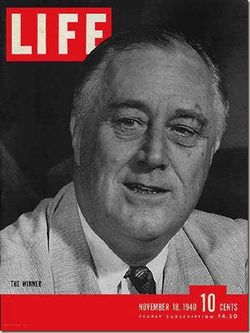
 What would Democrats have done in 1940 had FDR been term-limited?
Every generation of American politics has some things in common with generations that came before. But the period that comes to mind now is that which came after the Crisis of 1932, which evolved into World War II.
As was the case then, the economic crisis and previous military conflict brought with it blowback. It created enemies who threatened the very foundations of the Republic. The difference is that while FDR faced a consensus against military conflict he had to reverse, this President faces a consensus in favor of military conflict that must be reversed.
As was the case in FDR’s time, when those against his Thesis of Unity misread the past, trying to make history repeat when the opposite tack was called for, so the case against Obama’s Thesis of Consensus is based on a misreading of history.
Back then, of course, Republicans were isolationist. Many even found Mr. Hitler compelling. These people did not want America re-arming, and their control of Congress made it difficult for Roosevelt to coax the build-up of fear and passion necessary to face the challenge.
 The opposite is true in our time. Republicans today want to repeat the wars in Iraq and Afghanistan, and call this President cowardly for refusing to go to war in Syria. Obama shares their concerns, but believes a more nuanced approach is called for, one in which Russia, Europe, and even the terrorists’ Saudi paymasters are gradually brought along to using every means at their disposal – economic power, diplomatic power, media power, and technological innovation – to wipe out not just people but ideas that are antithetical to 21st century progress.
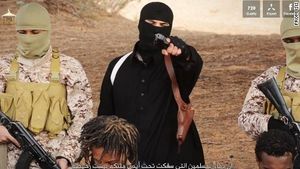
Meanwhile, the drums of war beat on. The ISIS attack on France has acted like 9-11 on French public opinion. The human weapon of the Syrian refugee flood had already caused many Europeans to turn their backs on their own values, a huge victory for the enemy, and America’s Republicans seem anxious to repeat that mistake here.
What happens if the flood can’t be absorbed? What happens is that ISIS multiplies. What if it is absorbed? For every peaceful Syrian family absorbed into the West, that’s two or three families where extremism will find no haven. It’s the refugees that are the Atomic bomb in this war, and that bomb went off months ago.
 What is at stake today is whether conflict or consensus will be the order of the 21st century. Will we find new ways to repeat the mistakes of our past, a past marked as much by mass death as it was by technological progress, or are we going to find a way to meet the real challenge of the 21st century, the War against Oil, the conflict that will define whether human beings can survive in the 22nd?
Just as Hitler found precedent for his genocide in American eugenics and for his expansionary policy of Lebensraum in our “taming” of the West, so the men of ISIS find precedent for what they are doing hidden in America’s past, the 1933 agreement between Texas oil and Saudi Sheikhs that created Aramco.
 The name Aramco originally stood for Arabian-American Company. It was a commercial agreement signed by Standard Oil of California, then taken over by Texaco and Exxon, and eventually absorbed into the Saudi family-state, calling for the exploitation of the Kingdom’s vast oil wealth, with the technology and marketing done by Texans.
The alliance between Texas and Arabia created centers of vast economic power, which in time became political power. Texas has since given the U.S. three Presidents, while controlling far more. The Saud family, meanwhile, used its political power to spread its Wahhabi version of Sunni Islam across the region.
If Aramco is the Lebensraum of Saudi power, Wahhabism is its eugenics. Wahhabism, like medieval Catholicism, countenances no complexities in the human heart. As with the church of the Crusaders, it sees no peace among religions, not even within Islam. Apostates like Iran’s Shiites are feared and hated just as Jews and Christians are feared and hated.
 Saudi Arabia, of course, combines the charms of the Spanish Inquisition with the glories of Louis XVI’s France. Saudis are sinners. (Actually, they’re human, but in the view of their religion they’re terrible, terrible sinners.) Like Texans going to Mexico, they wander the globe seeking a good time, then come back and pretend that it’s all good at home. It’s a set of contradictions that were bound to explode.
And, of course, they have. Osama bin Laden was a Saudi citizen, his family owners of one of the Kingdom’s largest construction companies. There are more Twitter followers of ISIS in Saudi Arabia than there are anywhere else. Without Saudi money, without the Wahhabist ideology, ISIS would collapse.
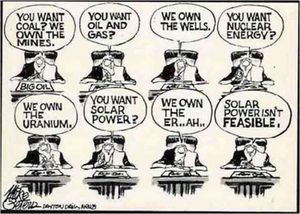 At the same time we have the Texas side of the equation. Texas has used its political power in the same way the Saudi royal family has. They insist their shit don’t stink, that absolute adherence to their values is the only way to live, and they treat Arabs as recalcitrant children who must be disciplined with guns and bombs. Thanks to the Cold War, there are plenty of guns and bombs to go around.
What do the two sides in this global conflict, the Texan and the Arabian, have in common? The same thing they did 80 years ago. Oil.
What is sold as a war of civilizations, or a war between religions, is in fact an economic conflict, and a battle for the future of this planet. I began calling this blog The War Against Oil when Al Gore was flogging the “climate crisis” and renewable energy technologies were in their relative infancy, arguing that politics would change only when economics and technology forced that change.
Now it can.
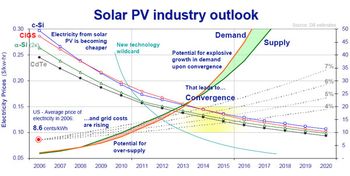 As was predicted here in 2010, 2015 represented “crossover.” This was the point where the costs of solar energy crossed below those of fossil fuels. This was based, of course, on 2010 prices. The economic response of the oil power has been a glut, of both oil and natural gas, which cut the costs of fossil fuels by more than half.
After crossover, I stated back then, the costs of renewables would not stop going down. They would keep dropping. This is in the process of happening, although the fall in fossil fuel prices has strangled some renewable investments, and cut the value of even well-run companies like First Solar.
But this remains the battlefield. Texas owns half of our political system. It is bidding to control all of it. It will use that power as it is using it in the states, to seek to strangle renewable energy investment, to double down on oil, while getting prices up through armed conflict against its Saudi doppelgangers.
The same criticism those who saw the danger clearly made of Roosevelt, meanwhile, is being made against Democrats today. Al Gore, in particular, considers the Administration slow-moving in tackling the Climate Crisis. I happen to think this crisis President has acted much as FDR did, moving only as quickly as domestic politics would allow, but moving nonetheless.
It will be up to the next President to prosecute this war, and as I said at the beginning of this essay our Roosevelt can’t sound the charge.
 Instead we have a leader who seems to have stepped right out of the nation’s history books. The Clinton Administration today is as much “ancient history” to most Americans as World War I was to the people of 1940, yet here is Hillary Clinton, whose influence peaked in those years, stepping forward and asking for power.
She has the support of the Administration, but she’s no Barack Obama. He’s Reagan, she’s Nixon.
That’s what makes the coming political struggle so compelling, and so potentially tragic.