

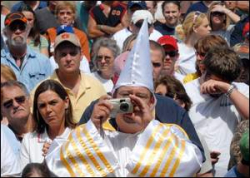
 That’s a pretty nasty headline, isn’t it?
All lives matter. Obviously.
A friend was offended, however, when she saw demonstrators recently chanting “Black Lives Matter.” She made the same point as above. All lives matter, she said.
I lit into her, but good.
Of course, all lives should matter. But black lives still don’t. There is abundant evidence to that effect, far too much to recount here.
I have written several times in the last decade that we’re now in a “fourth riding of the KKK,” and events have borne that out. That’s how history will record our time.
 The problem with the idea of “white lives matter,” as rhetoric, is its implication other lives should not. That’s what unites the Republican politics of the last generation. It’s the through line from Lester Maddox and George Wallace, through the Southern Strategy, to Willie Horton, and on through the Tea Party to Donald Trump. In fact, it has been part of our history since the beginning.
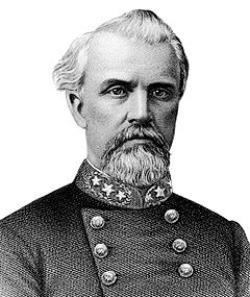
White, working class grievance has always been a salient feature in American politics. It was what distinguished Andrew Jackson from John Quincy Adams, who became an anti-slavery lawyer after being defeated in 1828. It animated both the Confederacy and those Democrats who countenanced it. It rode with Nathan Bedford Forrest, it was at the heart of William Jennings Bryan’s appeal. The white riots that overtook Atlanta, Tulsa and other cities helped elect Woodrow Wilson, by far our most racist President, in 1912, and the racism at that time was so general it was barely remarked upon by historians for many decades, who continued to class him as a progressive for creating the Federal Reserve and for his 14 Points, until very recently.
Whenever black people seem to be advancing, white working class grievance rises, and so does the Klan. It was there in Bull Connor’s hoses, and in the murders of the Civil Rights era.
What many still don’t appreciate is just how thoroughly Jim Crow has been revived in our own time, in the South where I live. Instead of segregated public schools, we’ve had public schools starved of funds and whites educated at private academies. Instead of whites-only housing, we’ve had zoning and property tax systems designed to separate economic classes, and encourage the black middle class to self-segregate for the resulting bargains.
 There are white victims as well as black. The difference is where their ghettoes lie. West Virginia is once again Appalachia, the only jobs those meant to serve the needs of rich lowlanders. Even factory jobs now require more education than poor whites can afford, so they’re left with service work that has lacked a wage floor which could keep a family together. The drug plagues we talk about in the black community have ripped through white ghettoes too, every one.
The only routes out for the white working class have been in the military and police services. Thus many have taken the attitudes, tribalism, and ignorance into jobs they were raised with in the black ghetto. The blue line of omerta, in which police are always defended, their detractors always disdained, has led to the fourth riding, especially given the image of a calm, relaxed black man from Hawaii occupying the seat of power in Washington.
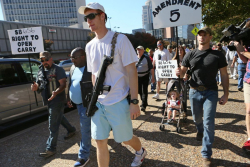 The clearest evidence of racism lies in our gun laws, or lack of them. White working class men can buy an AR-15 and march through fast food restaurants with impunity, sneering at those who cower before them. Even a toy gun will get a black man killed. Having no gun at all can do it. A few cops have been fired, even fewer have been charged, but you won’t see one convicted.
How can this do anything but fuel a counter-rage by the victims of these horrors, and a new civil rights movement meant to give all citizens some of the advantages a young mixed-race kid in Honolulu got from his white mother and grandparents, so many years ago. Yes, there are black millionaires now, even black billionaires. There are great black intellectuals, and artists, scientists and business leaders. But when a black man (or woman) rises they move to the suburbs or a high-rise. The black lower class remains more isolated than it was in Dr. King’s time.
All these things have been clear to me, a white man, from the moment I moved to my east Atlanta neighborhood 33 years ago. I was welcomed here, warmly, by good middle-class people who had lived through Civil Rights and appreciated the life their hard work had earned them. Many of their children and grandchildren remained middle class. Some fell back. As they aged out and went to their rest, they left me educated, aware, and grateful for their example, for their morality, and for their values, which I have tried to make my own.
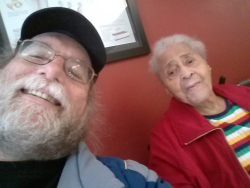 I went to visit one such woman, who has since passed at the age of 101, soon after Barack Obama’s election. I knew her father, who lived to be 102, and I recalled how I’d told him about my dad being a TV repairman, asking about his family upon first meeting him. What did they do, I asked? “They were slaves,” he said calmly, and then went back to the work of trying to make his centenary, because he knew his family and friends were expecting that of him.
My black neighbors lived for others. For their families, for their churches, for their community, for the example they could set. My life has been a piss-poor imitation, but then I don’t have to be any better than I am, because I’m white, and my life matters regardless of how I lead it. When policemen see me, they smile and wave. I smile and wave back. Even my kindliest, saintliest black neighbors have never gotten that.
All lives should matter. But until black lives matter just as much as my life does, then they don’t. So Black Lives Matter. Amen.



“Yes” to all of the above. I am more in tune with black problems and fears than most older white men because my wife, stepchildren, and grandchildren are all black. We’ve watched plenty of store clerks treat my wife with suspicion or disdain or ignore her altogether — until I walk up, which usually means they set their “nice” switch to “on.”
Re Black Lives Matter: I heard somebody say we should mentally append “too” to those three words, and I’ve seen a number of people point out that wanting to save the whales doesn’t mean you’re anti-dolphin. Nice analogy.
And in Tampa, a group of black pastors is promoting their home-grown “Your Life Matters” movement, which is very much about cutting down black-on-black violence. And police? Their lives matter (too), right? And police (again)? That black guy sitting on the porch, looking ragged and slightly stoned? His life matters too — if not to him then to his Mom. Please don’t forget this.
Thanks,
-Rob
“Yes” to all of the above. I am more in tune with black problems and fears than most older white men because my wife, stepchildren, and grandchildren are all black. We’ve watched plenty of store clerks treat my wife with suspicion or disdain or ignore her altogether — until I walk up, which usually means they set their “nice” switch to “on.”
Re Black Lives Matter: I heard somebody say we should mentally append “too” to those three words, and I’ve seen a number of people point out that wanting to save the whales doesn’t mean you’re anti-dolphin. Nice analogy.
And in Tampa, a group of black pastors is promoting their home-grown “Your Life Matters” movement, which is very much about cutting down black-on-black violence. And police? Their lives matter (too), right? And police (again)? That black guy sitting on the porch, looking ragged and slightly stoned? His life matters too — if not to him then to his Mom. Please don’t forget this.
Thanks,
-Rob