This is the question Ray Liotta asks Kevin Costner’s character in the movie Field of Dreams. Costner’s response, “No, It’s Iowa” reflects the fact that while the cornfield may look like heaven to Liotta’s Shoeless Joe Jackson, Iowa is a real place with real problems. The look on his face says something different.
The same is true for Utrecht.
In Utrecht, renters live in long rows of small houses, public spaces at ground level, bedrooms and baths up thin and dangerous staircases shoved into corners. There’s barely space for a bush, meaning everyone is close to everything.
Just not as close as in the last century. The tiny shops that once dotted the corners are gone, replaced by larger markets with better prices, even a huge mall near the train station a mile away. The walkable neighborhoods are still bikeable, but longtime residents fear something fine has been lost.
Discrete Charms of the Bourgeoisie
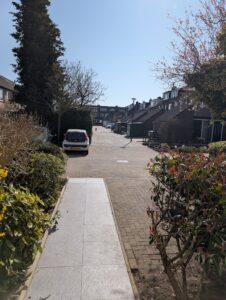 The section of Maarssen where I am staying is less than 5 miles from the city center. Land use is as segregated as it is in America. Commercial and office work is shoved into one corner and everything else is suburban housing.
But there’s plenty of parking.
The homes are the same as in Utrecht. What’s different is that Maarssen homeowners also have a postage stamp yard in which they take great pride, a brick shed in which to store stuff, and a driveway.
The design creates a quiet, private quality young people call boring. Kids as young as 10 have fat-tired “Class 3” bikes, even real motorcycles, in which they zoom up and down the bike paths in the evening. It’s embarrassing when 10 year-old kids have hotter rides than 70 year old tourists are allowed. But that’s Utrecht.
The kids want to be seen as dangerous. I’ve talked to several and they’re not. Still, they are bored, which comes out in graffiti along the train lines, more than along the MARTA back home. Even the toilets are tagged.
Car? Or No Car?
 There is a class distinction between folks like those renting me this place, whose cars let them live an hour or more away, and those who either must live without cars or choose to. (It’s a big financial commitment.) Most people in Maarssen choose to have cars. (There’s a section of Maarssen east of the canal, freeway, and train line, called the “Dorp” or village, that looks like Utrecht, only with cars.) In fact, most people who depend on cars don’t go into Utrecht, just as many Georgians who have them avoid Atlanta.
The mindset in the two places isn’t that different. The infrastructure is.
People in Utrecht can choose not to have cars because the country invested in shared infrastructure. (Behind these businesses in the Maarssen village, or Dorp, there are many cars.) In Atlanta, we didn’t. I just saw a woman in my Atlanta neighborhood complaining that a planned development for the poor, defined as people making $24,000/year, would bring in traffic. It might.
The Leidsche Rijn
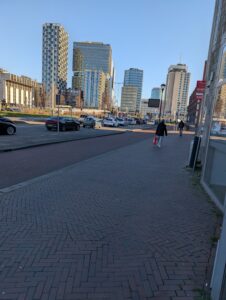 Knowing their city must grow, Utrecht has expanded into the west, an area called the Leidsche Rijn. This is the 21st century Utrecht, lots big enough for car dealers, modern college campuses, factories, and sunlight. You can still bike there. They’re very proud of that.
But coming into town through it the other day, it felt more like Maarssen than Utrecht. The roads are wide, and while there are bike paths alongside them, they’re less used than in the center of town. That’s because the Leidsche Rijn has parking.
The Leidsche Rijn is where the future of Utrecht will be decided. Can you have 21st century amenities while maintaining the closeness of the 19th?
So far, the answer is no. But cars aren’t self-driving yet. They’re still sold, not rented. The e-transport revolution is not yet over. It’s technology that will drive the future.