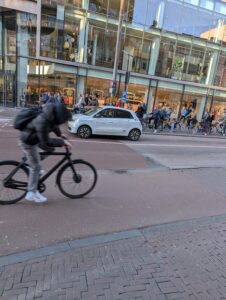
 This should be obvious to everyone. But for those car heads in the back, it needs to be said again and again and again.
Bikes do not compete with cars. That’s not their function. They are complementary to cars.
Fietsing, which is bicycling for transportation, is a city thing. Let Tadej and Jonas cover the longer distances, with 100 cars behind them filled with jel packets, water, and extra bikes. Fietsing is about getting around.
It’s easy to see fietsing’s limits after just a few days in the Netherlands. A bike is great for intra-city trips. If you’re going 5-10 kilometers (3-5 miles) for work, for school, for shopping, or for a meal, a bike is the obvious choice.
But I rode yesterday from Utrecht to the suburb of Breukelen and biking is not an inter-city solution. I’m tired today.
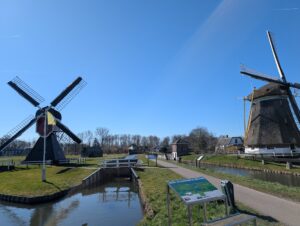 It’s true. The paths were gorgeous. I had a lot of fun. But Utrecht to Breukelen is not a long ride. It’s not even 10 miles. And it’s at the outer limits of a practical commute. I could do it in Atlanta, because I once rode to a physical therapy appointment on a lark. But it’s at the outer limit even if you give me a practical route where I’m not fighting giant pick-up trucks for inches along the edge of the roadway.
Here’s a fact you may not know about Utrecht. It has cars. Lots of cars. Many people in Utrecht commute by car. Many people live an hour away by car and never use a bike, except in their own neighborhoods. But because Utrecht makes bicycling practical, there aren’t many traffic jams. There’s room for a car in Utrecht, especially if it rolls at a bike’s speed.
It’s All in the Planning
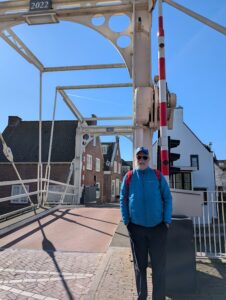 I’m not trying to sell you the Brooklyn Bridge here. (Yes, that’s me in Breukelen, a Utrecht suburb from which Brooklyn gets its name. Yes, that span behind me, built in 2022, was named the Brooklyn Bridge, because New Yorkers helped Breukeleners survive World War II.)
Bikes and cars don’t have to compete. Utrecht has a population density of about 9,500 people per square mile. Atlanta’s is just 670, although there are higher concentrations along Peachtree and near downtown.
It’s in those areas that bikes are making inroads, and where they should be making inroads. Practical routes through high density areas don’t compete with car traffic. They reduce it. You can still get in from Duluth or Kennesaw, but when you get near Georgia Tech, you’d be going 20 mph anyway. So why are you fighting something that will let you get around there, taking local traffic out of your way?
What would you rather see, a couple of bikes beside you or two more SUVs in front?