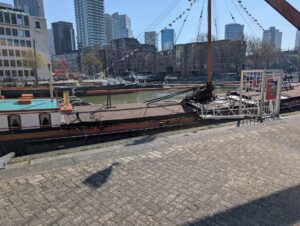
 American fietsers like me are usually pointed toward Rotterdam, rather than a city like Utrecht or Amsterdam, for a very good reason. I learned about it this week.
Rotterdam was destroyed during WWII and rebuilt along American lines. High buildings, wide roads, and cars everywhere. The city’s metro area is far bigger than most Dutch cities, meaning commutes are longer and cars are often necessary.
This makes it a better model for change than any American city.
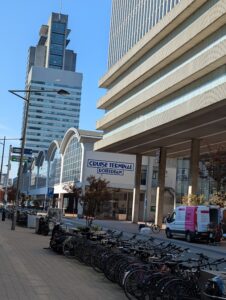 The wide roads have been narrowed, and speeds reduced for the new bike city of the 21st century. A 5 km (3 mile) commute is more than reasonable on a bike, at any time of the year, and an e-cargo bike can replace the family minivan. Replacing cars with bikes saves enough money that you can afford the rent, and you wind up close to everything else you need, because schools, shops, and entertainment follow money, they don’t lead it.
The bike lanes aren’t like those of Utrecht. They’re less crowded, easier to navigate. But that doesn’t mean they’re empty. Bikes, e-bikes, cargo bikes, electric trikes, mobility scooters and too many motorbikes dance around each other and (except for the motorbikes) it’s surprisingly quiet. Opa Fiets felt safe, despite still working on the Dutch biking vocabulary.
The segregation that makes this possible can be seen inside the MaasTunnel, with separate tubes for walkers, bikers, and cars, which comes up on its north side near the EuroMast, the city’s answer to the Seattle Space Needle. You can come up onto a highway in a car, or on a bike you can come up onto a park. Your choice.
The Demographic Changes
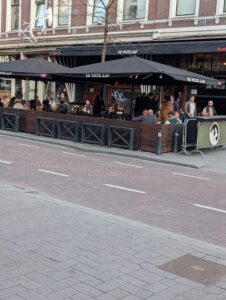 What I observed, biking around the city center, was less the physical changes that come from bicycling than the demographic ones. The tour guide was thrilled to talk about the area around Nieuwe Binnenweg, now filled with commerce, once a slum. By corralling the cars, and favoring two-wheel transport, Rotterdam brought young people from the upper middle class into the city center. This is precisely what Atlanta did with the Beltline.
I stayed on Witte de Withstraat, the closest thing they have to Bourbon Street. It’s lined with music clubs that go until late at night. But it was safe, because the partygoers had jobs to get to in the morning.
The result is a huge demographic change from what I’m used to. There’s money in the center, and poverty is pushed to the edges. It’s precisely what Atlanta needs as intown neighborhoods gentrify. Poorer residents are pushed out toward I-285 and beyond. Atlanta city leaders talk about “affordable housing” but those on the Beltline and in West Midtown can afford their lifestyles. It’s those who used to live there who can’t.
In Rotterdam, these become the suburban poor. With a dense, wealthy core, you don’t “drive until you qualify.” You get as close to the action as you can.
Not Easy to Do
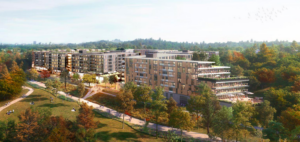 I won’t live long enough to see anything like this in Atlanta.
It takes commitment, and money, from every level of government to rebuild a city around bikes. Mostly, it takes a commitment to density, to people with money living close together.
Atlanta doesn’t have that. Witness the madness whenever intown density is even proposed, like at Amsterdam Walk.
“Where are we going to park?” the NIMBYs cry. The answer is, you’re not. If an area has segregated bike infrastructure leading to shopping, culture, and entertainment, why would you need to?
Central Rotterdam has cars and parking garages. They are visitors. They pay for the privilege. Intown gentry should have better things to do with its money.
None of this will happen without leaders at all levels of government supporting the infrastructure needed for density to thrive. That means buses, trams, and trains that run with frequency, and safe spaces for bikes separate from sidewalks and roadways. It means turning our backs on those living rooms on wheels, or those lawn care shops on wheels, that now dominate intown neighborhoods.
The very structure of Atlanta government stands against this. Atlanta competes for resources with its suburbs, many of which think they’re their own urban centers. Low population density means state leaders still think “one more lane will fix it.”
What I learned in Rotterdam is that a better way of life is possible. Maybe by the time your grandchildren have grown the Atlanta region will figure this out.